


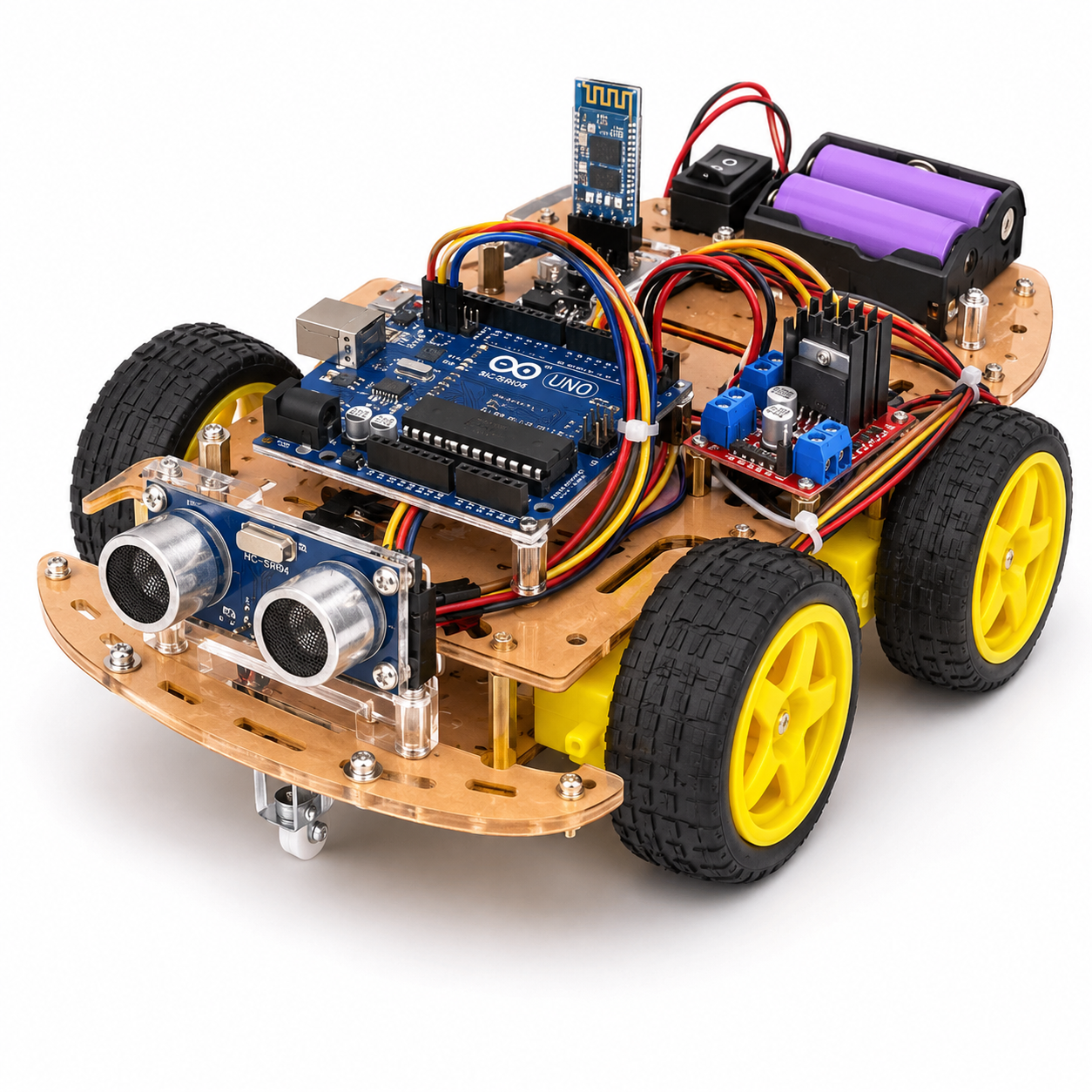
4WD Arduino Smart Robotic Car Kit
₨7,000.00
Delivered All over Pakistan 🇵🇰
The unassembled Arduino Robotic Car Kit features a 4WD platform for exploring robotics, motor control, Arduino programming, and automation. It offers hands-on learning through robot assembly and development.
Description
Introduction to 4WD Arduino Smart Robotic Car Kit
The 4WD Arduino Smart Robotic Car Kit (Un-Assembled) is a practical DIY robotics project that helps users build and explore a four-wheel-drive robotic vehicle. It provides a hands-on platform for learning Arduino programming, motor control, electronics, embedded systems, and robotics.
Moreover, the unassembled format lets users understand the robot’s construction by assembling its components step by step. In addition, Arduino’s broad community and available learning resources make it easier to explore programming and troubleshoot common issues.
Furthermore, users can customize the project with additional sensors and modules. Therefore, the kit is suitable for students, hobbyists, robotics enthusiasts, STEM activities, and prototype development.
How the 4WD Arduino Smart Robotic Car Works
The robotic car uses an Arduino-compatible controller to manage the motors and other connected components.
First, users assemble the chassis and attach the wheels, motors, controller, and required electronic parts. Next, they connect the components according to the selected circuit and control setup. Then, users program the Arduino to control the movement of the four-wheel-drive platform.
If compatible sensors or communication modules are added, the controller can process their input and perform additional functions. As a result, the robot can support different experiments and customized applications.
Additionally, compatible modules can add features such as obstacle detection, line following, Bluetooth control, and IoT connectivity.
Components Included in the 4WD Arduino Smart Robotic Car Kit
The kit includes the following components for assembling and experimenting with a four-wheel-drive robotic vehicle:
| Component | Quantity |
|---|---|
| Arduino UNO Board | 1 |
| L298N Motor Driver Module | 1 |
| Acrylic Robot Chassis | 1 set |
| DC Gear Motors (TT Motors) | 4 |
| Robot Wheels | 4 |
| HC-SR04 Ultrasonic Sensor | 1 |
| IR Line Tracking Sensor Modules | 2 |
| IR Remote Control | 1 |
| IR Receiver Module | 1 |
| Battery Holder | 1 |
| 18650 Rechargeable Batteries | As supplied |
| Jumper Wires | As supplied |
| USB Programming Cable | 1 |
| Screws, Nuts and Spacers | As supplied |
Note: Component quantities and battery specifications should be verified against the actual package contents.
Key Features & Specifications
- Type: 4WD Arduino smart robotic car kit
- Assembly: Un-assembled DIY kit
- Controller: Arduino UNO compatible control board
- Drive System: Four-wheel drive
- Motor Driver: L298N dual H-bridge motor driver
- Motors: Four DC geared motors
- Sensors: Ultrasonic and IR line tracking sensors
- Control: Arduino programming
- Customization: Supports compatible sensors and modules
- Learning Areas: Robotics, programming, motor control, and embedded systems
- Applications: STEM, DIY, educational, and prototype projects
- Design: Suitable for beginners and robotics learners
Circuit Connections
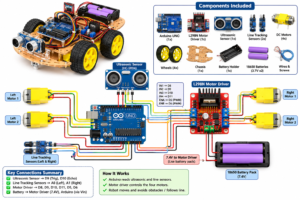
The following pin configuration can be used for an obstacle-avoiding robot using the Arduino UNO and L298N motor driver.
| Component | Arduino Pin |
|---|---|
| Ultrasonic VCC | 5V |
| Ultrasonic GND | GND |
| Ultrasonic TRIG | D9 |
| Ultrasonic ECHO | D10 |
| Left IR Sensor OUT | A0 |
| Right IR Sensor OUT | A1 |
| L298N IN1 | D5 |
| L298N IN2 | D6 |
| L298N IN3 | D7 |
| L298N IN4 | D8 |
| L298N ENA | D3 (PWM) |
| L298N ENB | D11 (PWM) |
Motor connections:
- Left-side motors connect to L298N OUT1 and OUT2.
- Right-side motors connect to L298N OUT3 and OUT4.
- Connect the battery supply to the motor driver’s power input.
- Connect Arduino GND and motor driver GND together.

Arduino Programming Code – Obstacle Avoidance Robot
The following Arduino sketch provides a basic obstacle-avoidance function. The ultrasonic sensor measures the distance in front of the robot. When an obstacle is detected within the set distance, the robot stops, reverses, and turns.
Required components: Arduino UNO, L298N motor driver, four DC motors, and HC-SR04 ultrasonic sensor.
// 4WD Arduino Smart Robotic Car
// Obstacle Avoidance Program

// L298N Motor Driver Pins
#define ENA 3
#define IN1 5
#define IN2 6

#define ENB 11
#define IN3 7
#define IN4 8

// Ultrasonic Sensor Pins
#define TRIG 9
#define ECHO 10

int motorSpeed = 160;
int obstacleDistance = 20;

void setup() {
  pinMode(ENA, OUTPUT);
  pinMode(IN1, OUTPUT);
  pinMode(IN2, OUTPUT);

  pinMode(ENB, OUTPUT);
  pinMode(IN3, OUTPUT);
  pinMode(IN4, OUTPUT);

  pinMode(TRIG, OUTPUT);
  pinMode(ECHO, INPUT);

  Serial.begin(9600);
  stopCar();
}

void loop() {
  int distance = getDistance();

  Serial.println(distance);

  if (distance > 0 &&
      distance <= obstacleDistance) {

    stopCar();
    delay(300);

    moveBackward();
    delay(500);

    stopCar();
    delay(200);

    turnRight();
    delay(500);

    stopCar();
    delay(200);

  } else {
    moveForward();
  }
}

// Measure distance using HC-SR04
int getDistance() {
  digitalWrite(TRIG, LOW);
  delayMicroseconds(2);

  digitalWrite(TRIG, HIGH);
  delayMicroseconds(10);

  digitalWrite(TRIG, LOW);

  long duration = pulseIn(ECHO, HIGH, 30000);

  if (duration == 0) {
    return -1;
  }

  return duration * 0.034 / 2;
}

// Move Forward
void moveForward() {
  analogWrite(ENA, motorSpeed);
  analogWrite(ENB, motorSpeed);

  digitalWrite(IN1, HIGH);
  digitalWrite(IN2, LOW);

  digitalWrite(IN3, HIGH);
  digitalWrite(IN4, LOW);
}

// Move Backward
void moveBackward() {
  analogWrite(ENA, motorSpeed);
  analogWrite(ENB, motorSpeed);

  digitalWrite(IN1, LOW);
  digitalWrite(IN2, HIGH);

  digitalWrite(IN3, LOW);
  digitalWrite(IN4, HIGH);
}

// Turn Right
void turnRight() {
  analogWrite(ENA, motorSpeed);
  analogWrite(ENB, motorSpeed);

  digitalWrite(IN1, HIGH);
  digitalWrite(IN2, LOW);

  digitalWrite(IN3, LOW);
  digitalWrite(IN4, HIGH);
}

// Stop Robot
void stopCar() {
  analogWrite(ENA, 0);
  analogWrite(ENB, 0);

  digitalWrite(IN1, LOW);
  digitalWrite(IN2, LOW);

  digitalWrite(IN3, LOW);
  digitalWrite(IN4, LOW);
}
Important: This is a basic obstacle-avoidance example, not a complete line-following or Bluetooth-control program. Depending on the motor orientation, you may need to reverse the motor polarity or change the direction logic. Connect the four motors in two groups according to their current requirements. Ensure the battery voltage and motor driver ratings are suitable. Use a common ground between the Arduino and motor driver.
Applications & Use Cases
The 4WD Arduino Smart Robotic Car Kit can be used in schools, colleges, universities, robotics clubs, workshops, makerspaces, and final-year projects.
For example, students can assemble the kit and learn how an Arduino controller operates multiple motors. Similarly, learners can develop practical knowledge of Arduino programming, circuit wiring, motor control, sensor integration, and robotic systems.
In addition, the platform can support upgrades using:
- Ultrasonic Sensors: For obstacle detection and distance measurement.
- Bluetooth Modules: For wireless smartphone control.
- IR Line Tracking Sensors: For automatic line-following functionality.
- Cameras: For computer vision and image-processing experiments.
- IoT Modules: For remote monitoring and smart robotic applications.
Furthermore, the unassembled design encourages users to understand each component and its role in the robot.
As a result, the kit provides an engaging platform for exploring robotics, automation, embedded systems, and smart vehicle control.
Learning Benefits
By assembling and programming this robotic car, users can develop practical skills in:
- Arduino programming and coding.
- Electronic circuit design and connections.
- DC motor control and H-bridge operation.
- Ultrasonic distance measurement.
- IR sensor applications.
- Robotics and automation fundamentals.
- Embedded systems and hardware integration.
- Troubleshooting and DIY project development.
Conclusion
The 4WD Arduino Smart Robotic Car Kit (Un-Assembled) combines hands-on assembly, electronics, and programmable functionality in one educational robotics project. Its four-wheel-drive platform and compatibility with different sensors make it a useful starting point for beginners and experienced robotics enthusiasts.
Whether used for STEM education, DIY experiments, or advanced robotics projects, this kit offers an exciting opportunity to explore the fundamentals of intelligent robotic vehicles.
Visit our website Ampflick for more products.
You can also visit our Instagram and Facebook for the latest updates.
Only logged in customers who have purchased this product may leave a review.
Related products

-
Sale!
Ultimate Starter Component Box4 | Arduino Uno Kit Pakistan
- Original price was: ₨6,180.00.₨6,000.00Current price is: ₨6,000.00.
- Add to cart
-
Sale!


Reviews
There are no reviews yet.